Showing posts with label Teaching engineering. Show all posts

Friday, 24 April 2015

The Meaning of Silence

Most of us who write on here have written articles on the problems of engineering education in print publications.

These are usually published in engineer's professional journals or in the general press, as we have found it hard to get articles about the problems with engineering education published in journals controlled by educationalists.

Eventually we run into problems with even those publications which  will publish articles about the mismatch between engineering degrees and the engineering profession.

If we are bold and forthright in our criticism of current practice, we are told that we cannot say anything which might be thought disrespectful of individuals.

If we are more diplomatic, we are told that our new articles on the subject are just rehashing what we said before, as they have the same basic theme.

The response to the articles is consistently positive from practitioners. The most interesting thing is the response from academics. Silence. They generally speaking don't have a thing to say in public about these issues.

They only want to talk to people who agree with their basic axiom that engineering is the straightforward application of the far more difficult maths and science which they know about.

If you suggest that engineering is not the application of natural science and maths - silence.

If you suggest that the graduates they are producing are not fit to become engineers- silence.

If you suggest that a practitioner might know hard things that an academic does not - silence.

If you suggest that putting scientists and mathematicians in charge of engineering education was a bad idea - the utter silence of censorship. Not only they, but you will be silenced.

So much for the principle of academic freedom. Some things may not be said, and will not be said in peer-reviewed academic journals, or professional engineering journals.

So what does the silence mean? You can pin down academics in a corridor, and get a few answers:

1. "That's just technician level knowledge"
2. "I'm in touch with one of our alumni, and he says that engineering practice is exactly as we in academia say it is"
3. "Oh, that's the kind of thing X always says, pay no attention to him"
4. "All of our graduates get good jobs - Where's the problem?"
5. "University is about Education, not mere Training"  
6. "I AM an engineer, so the stuff I teach IS engineering"
7. "All of the faculty agree that this is what engineering is about"

There are many others, but what they all have in common is their thought-avoiding dismissiveness.

Technicians know things many professors do not. Much of this knowledge is needed to become a professional engineer, but most of what is missing is not known by technicians or academics. The technician level knowledge argument is an insult to professional engineers and technicians masquerading as an argument. Professional engineers know the theory that academics know, as well as the practicalities that technicians and professional engineers know. They will tell you that engineering is far more complex than the things they were taught in university.

The kind of alumnus who keep in touch with the kind of person who tries the "one of our alumni once told me" argument tends to be a bit of a suck-up. n=1 would not impress this kind of academic in any other sphere, but when it comes to confirmation bias, any datapoint which agrees with prejudice will do.

"That's the kind of thing X always says" is a straightforward ad hominem attack, backed again only by a lack of criticality founded in confirmation bias. Maybe that is what X always says, but please explain why he is wrong.

Data in this area is very flaky, but not so bad that we cannot say with some confidence that all of your graduates do NOT get good jobs. Many of them may not get jobs at all, and most of them will not get jobs as engineers. Would people teaching medicine be as unconcerned if less than half of their output were thought fit to practice?

Education vs training is the expression of snobbery of people who don't know what engineers do, but think that what they know is smarter than what engineers know, despite their not knowing what engineers know.

The researchers who say that they are engineers may have a point, but usually they don't. I read books by people like Vincenti, and I meet some academics who clearly know what engineering is about. I'm happy to call such people research engineers. It is very notable that such people's research is very directly useful to, and involves talking to practicing engineers.

"All of our faculty agree..." All of your faculty agree that if they are wrong about what engineering is they are going to have to do a great deal of work learning a subject they know next to nothing about from people they consider their social and intellectual inferiors. No-one will give them any reward for this work, and before they can do it, they will have to agree that they are the oompa loompas of engineering rather than the other way round.

What does the silence mean? It means that the present approach to engineering education is as morally bankrupt as it is intellectually lazy. It means that they hope we'll stop knocking if they ignore the door for long enough.

Wednesday, 1 April 2015

What's Wrong with Engineering Education From an Engineer's Point of View?

A lot of the difference between a beginner and an expert in engineering is to do with having a feeling for what matters. Expert engineers know which things are not going to work. They know the key metrics and heuristics which allow them to cut through complexity to be able to reliably predict the outcomes of situations which no-one can fully understand.

Vincenti explains all of this very well in "What Engineers Know and How They Know It", with the specific example of the "Flying Quality" of aircraft. Many educationalists would no doubt deny the possibility of the establishment of any reliable metrics for learning, let alone ingenuity, but I disagree.

I think that any good engineer can reliably and reproducibly tell a good engineer from a poor one sufficiently well to control the process of engineering education. Let us call the property they are estimating in making this judgement ingenuity.

As a good engineer I can tell from their average level of ingenuity that either the candidates I have been sent to make into engineers have been poorly selected, or (if these are indeed the best candidates available), the pool of sufficiently ingenious candidates is small.

I am not sure that I can see any significant differences in ingenuity between candidates of different genders, sexualities, skin colours and so on. It would not matter if I could, as it would be illegal for me to discriminate between candidates on these grounds (unless of course I was discriminating "positively", which I would rather not do).

Much of the discussion of how to improve engineering education centres on increasing numbers, both in general and of "under-represented" groups. The view of who is under-represented is however highly politicized. The great under-representation of the children of the working classes in engineering education is not apparently not a problem. The lack of a 50:50 gender ratio is however thought to be a problem. This is an ideological position, not a rational one. It is a political judgement, whose truth or otherwise is based on the acceptance or rejection of certain set of values and associated axioms.

We might set aside the issue of whether these values and axioms are right, and ask if this approach is likely to work, and if there is any evidence that it is working. But first we would have to agree about what "working" means. This is a problem I have come across many times in professional engineering practice. What is needed to resolve it rationally is an agreed metric.

In my recent discussions with Kel and Peter from the RAE, it seems clear to me that the immediate aims of the RAE's activities in encouraging applications to engineering courses are to produce twice as many engineering graduates, but that their ultimate aim is to produce more good engineers.

There is an implicit assumption in these approaches that more applicants in general, and more female applicants in particular will automatically lead to more good engineers. But this does not follow, whichever way you read the data on applications to engineering courses.

My belief is that we already train too many engineers in general, and poor engineers in particular. Even Peter's own figures suggest that almost half of our graduates are not being employed as engineers, and I think this analysis underestimates the problem due to the poor quality of its source data. Most professional engineers (including myself) think that today's engineering graduates lack ingenuity, and consider many of them unemployable as engineers.

The RAE's argument is that because some engineering courses have to go to "clearing" to make their numbers, we are not oversupplied with candidates. This to my mind still leads us to the conclusion that we have too many places available if our aim is to produce good engineers. Going to clearing means that these courses are taking on second choice students. If we believe that A-levels are measuring something which correlates with ingenuity, this dropping of standards reduces our chances of making good engineers.

Engineers have a feeling for the correct level of analysis. I have previously explained why I think analysis at the STEM level is unhelpful. Now I would like to explain why I think analysis at the "Engineering " level is unhelpful. Let us take the example of Chemical Engineering and Civil Engineering courses.

Even though only half of Chem Eng graduates get jobs as engineers, there has been a massive expansion in numbers and tariffs on Chem Eng Courses, and several new courses are being accredited. This may well be something to do that Chem Eng is the highest paid branch of engineering in the UK, more well paid than medicine. Chem Eng courses are 27% female, and Biochem Eng courses even closer to gender parity.

Contrast this with the least well paid branch of UK engineering, Civil Engineering. Civ Eng can't fill its courses, and it can't get the girls. So Civil Engineering may have a problem - does Chem Eng have the same problem? I think not. In my opinion Chem Eng is probably exceeding, and certainly approaching the saturation point for willing and able female candidates.

So it seems to me that in a system where we charge students £36K for an entry level engineering qualification, they are voting with their feet for the courses most likely to give a good return on their investment. Anyone who didn't wouldn't be a good candidate to be an engineer.

So it does not follow that some courses having difficulty making their numbers means that there is a crisis of recruitment in engineering courses. This might be a crisis for those working in the Civ Eng department, but if students don't care, and employers already have twice as many candidate as they need, why should engineering care? If we end up with too few civil engineers, it will presumably become better paid, but the laws of supply and demand suggest there are too many of them at present.

As well as the differences between disciplines, there are accredited and unaccredited courses, and courses at higher and lower status institutions. If the unaccredited courses at third rate institutions intended to cheat ill-informed students of their money (because institution and course status is often more important in the UK job market than degree classification) have difficulties filling their courses, this need not trouble Imperial College.

Employers have a vested interest in oversupply of labour, and even good universities will to some extent lay on courses for anyone willing to pay. Law now produces six times as many graduates as there are jobs as solicitors and barristers, and wages (though not fees) have crashed. We trained far too many pharmacists in recent years and what was a secure and well paid job has become akin to that of a shop assistant for many of those lucky enough to have jobs at all.

So when we strip out the unhelpful generalizations, special pleading and propaganda from vested interests, we see the following:

There is no general shortage of graduate engineers (or both employment rates and wages for graduates would be higher)

There may be local shortages of certain kinds of engineers and engineering students (but paying professional engineers more money can fix them)

Training more engineers will on the other hand not fix this problem, as it will (by increasing supply in a market which is already oversupplied) decrease both wages and the chances of employment for graduates and hence the attractiveness of undertaking our challenging and expensive courses.

Encouraging women to study engineering will not fix this problem (as there is no evidence that the profession suffers in any way because women generally prefer medicine to engineering)

It seems from Chem Eng's example that if it is politically desirable to increase the number of women in engineering education, paying engineers more seems to work.

So it looks to me as if much of what is presently being done is entirely wrong-headed, based in an uncritical acceptance of political propaganda.

We can however always use more good engineers. Maybe if we produced more of them we might once more have an economy based on designing and making things, driven by these good engineers.

In my opinion, many of the half of engineering graduates who get jobs as engineers should think themselves  lucky. More than 75% of them will never be good engineers. I have seen them in education, and I have seen them in practice, and they are just making up the numbers in my opinion.

I cannot tell reliably why this is. Have we already dipped to the bottom of the pool of natural engineers? Are engineers born or made? How can we reliably measure ingenuity? Can we foster it, and if so how? Are our present metrics of quality well correlated with ingenuity?

The answers to these questions are the key to making more of the good engineers we all think are needed. If we wasted less time on political agendas we'd have more time to find answers to them.

Saturday, 28 March 2015

Engineering Education: Are Degree Apprenticeships the Answer?


In James Atherton's post on our blog, he wondered whether the "call for a revival of graduate-level apprenticeships may finally be heeded".

It turns out it already has been, "Degree Apprenticeships" were rolled out mid-March, and we already had "Higher Apprenticeships", which allowed degree level study alongside vocational training.

There is however a problem with such approaches in a society as conscious of class nuance as the UK. As Alison Wolf pointed out, many consider vocational qualifications a great idea - for other people's children.The supposed equality of degrees in the UK is already a polite fiction.

In an article in "The Chemical Engineer" magazine discussing these changes,  they say "For hundreds of years, universities have offered up something philosophically different from vocational training courses - focussed on growing pure knowledge and understanding rather than simply making students ready for the world of work".

This sentence sums up a number of the key misunderstandings, generalizations, stupidities and manifestations of snobbery which will make any "Degree Apprenticeship" a second rate qualification in the UK.

What for example is "pure knowledge and understanding"?  Whatever that might be, it is nothing to do with engineering. Engineering may be "impure" in the sense of being applied and practical, but the application of the positive value judgement "pure" to knowledge and understanding is simply snobbery. Knowledge itself is neither pure nor impure, except that we judge it so.
 
The original purpose of universities was monkish study. Insisting that everything which takes place in universities has to conform with earlier ideas of their purpose is illogical. It is analogous to the lexical "root fallacy" where the true meaning of a word is its supposed original one. Words change their meanings, as do institutions. If it were ever true that universities were ever about what TCE magazine says they were, they aren't now.

In any case, chemical engineering only made it into universities in 1887. There can be no appeal to hundreds of years of tradition by chemical engineers. That first chemical engineering course (delivered by George E Davis, a practical working engineer and chemist now seen as the founding father of chemical engineering) was criticized by contemporary snobbish academic purists for being mere "commonplace know-how".

Such are the roots of chemical engineering, but it seems that it wishes it were higher-born. Medicine doesn't seem to worry about being a practical business, why should we? But of course in the UK, medicine is a profession, and an "engineer" rods your drains.

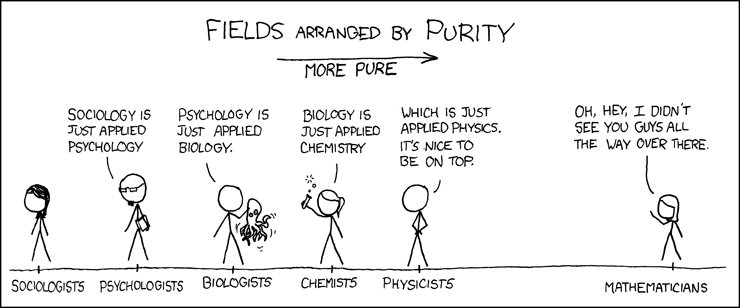
The cartoon at the top shows the hierarchy of purity in academia. There was not room in the frame for those teaching apprentices, who would be around a metre to the left of the sociologist at the scale used. Rather than insisting that the answer is a new qualification (understood by all to be for working class children) we need to remind engineering that it was never pure.

To get a job as an engineer, graduates need nowadays to have already experienced work as an engineer. Industrial placements, internships and so on are on the CV of every smart budding engineer.

So, what is the difference between a supposedly pure degree, with a year or so of industrial experience, and a job straight out of school with an applied degree on the side?

In terms of learning, nothing significant, (though there is every chance that the vocational students will be worked harder both at work and at university, and actually learn more). In a society alert to every shade of class distinction, everything.

The apprenticeship route will not be competing with Russell Group universities for the "best" A-level students, it is for the bright working class kids who don't get those grades. It will lock them into the slow lane in their professional lives, just as we have seen the old degree level technical apprenticeships do to those who took them.

Saturday, 21 March 2015

What Aren't The Problems of Teaching Engineering - And Why Are These The Issues We Are Addressing? #1: "The STEM Shortage"

Those in engineering education whose hearts are in the right place have a vague feeling that there is something wrong with the education they are providing.

It is however made very hard for them to identify the real problem, as the discussions are dominated by discussions of non-problems.

The first of these is the supposed STEM shortage. Our well-meaning investigator talks to supposed experts, and reads the educational press and they are given a strong impression that the real problem in engineering education is a shortage of STEM graduates.

It is however far from clear that there is a shortage of STEM graduates as Stephen Gorard and The Atlantic Magazine pointed out a few years ago. The data simply is not there to support what has become the basis for almost all discussions of the subject. Those who get jobs as engineers may attract high wages, but only half of engineering graduates get to work as engineers.

There are vested interests who might wish all discussions to be based on this axiom. Universities, Employers, and Engineering Institutions all largely support the myth of the STEM shortage, arguably for reasons of self-interest.

In the UK, universities are ranked on their ratio of applications to accepted candidates. In many engineering courses this ratio may be as high as 10:1. There is no shortage of willing candidates for engineering degrees.

This does not however mean that university admissions tutors wouldn't like this marker of status to be higher. A higher ratio allows them to be pickier about the "tariff" of examination grades they will accept from candidates. This tariff is also a marker of status, reported in ranking tables.

There is no apparent upper limit to aspirations in these areas by universities, but this is nothing to do with making more or better engineers, as the pre-university exams have nothing to do with engineering ability. It is about managing the status of their institution.

A level results may correlate with degree classification, but degree classification does not have a simple relationship with ability as an engineer. This is in my opinion due to the lack of engineering in engineering degrees.

So if there is no evidence to support the idea that there is a shortage of applicants for STEM courses, perhaps there is (as employers organizations regularly claim), a shortage of STEM graduates?

Not only is there no evidence for that, there is strong evidence to the contrary. An uncomfortably high proportion of STEM graduates cannot get jobs in STEM. Surely if there are shortages, even our poorest graduates would be snapped up, and wages would be rising? But that's not what is happening.

If there is no shortage of STEM workers, why would employers' organizations say that there is? As with so many things in this debate, much lies in confusion over terms. Sometimes this lies with the authors of press releases, and often with journalistic misunderstanding.

A "STEM shortage" might be a local shortage of staff with certain specific training, shortages of time-served tradesmen, shortages of doctors, or simply a shortage of workers willing to work for what employers are offering.

A shortage of trained staff might be fixed by an employer being willing to train. The present shortage of time-served staff was caused by persuading 50% of young people to go into HE. Shortages of doctors have nothing to do with supply of engineers, and the last category is entirely soluble by a wage rise.

This last is presumably the reason why employers institutions are supportive of  the myth of the STEM shortage - oversupply will drive down wages.

What we are NOT short of is people willing to undertake accredited engineering degrees, or STEM (including engineering) graduates. There is clear oversupply of both of these things (in some cases massive oversupply as with UK pharmacists at present)

We may be short of chartered engineers, though the answer to this is not to allow non-engineers (people without at a minimum accredited degrees in engineering, and ideally with five years of experience as an engineering practitioner) to carry the title, as our engineering institutions have done.

In any case, STEM (Science/Technology/Engineering/Maths/Medicine) is too broad a brush. It is the cause of engineering institutions being involved in campaigns which are of no benefit to engineers in particular or society in general.

Our institutions send people into schools to promote STEM, rather than engineering, but even promoting engineering in schools is often wrong-headed. The only beneficiaries of yet more unsuccessful applicants to wildly oversubscribed engineering courses are the universities.

As we are already producing worldwide around twice as many engineering graduates as there are jobs for, one would think that there is little point in expanding engineering education provision, but the debate is so ill-founded in HE that that is exactly what we are doing.

The STEM conflation is also the cause of the major problem of engineering education. It supports the many people in university engineering departments who think that they are providing a STEM education rather than an engineering one. They consequently make students learn irrelevant science and maths, and employ scientists and mathematicians to teach them.

There will always be a shortage of excellent engineers - even in engineering practice there aren't that many. My students mostly have three As at A-level, but I would consider only about 10% to really have the knack for engineering which is needed to make a great engineer. There is no real sign of a STEM shortage, but there does appear to be a knack shortage. I will discuss what I think the reasons for this are in another post.